
Key Takeaways (TLDR)
- Definition: An MVNO is a wireless provider that leases network capacity from major carriers (MNOs) like AT&T, Verizon, and T-Mobile instead of owning its own towers.
- 2026 Tech: Many modern MVNOs now utilize eSIM technology to make activations faster and easier and to support more specialized offerings.
- Why Choose One? You use the same network as a major carrier, often with better pricing, and features to better match your needs.
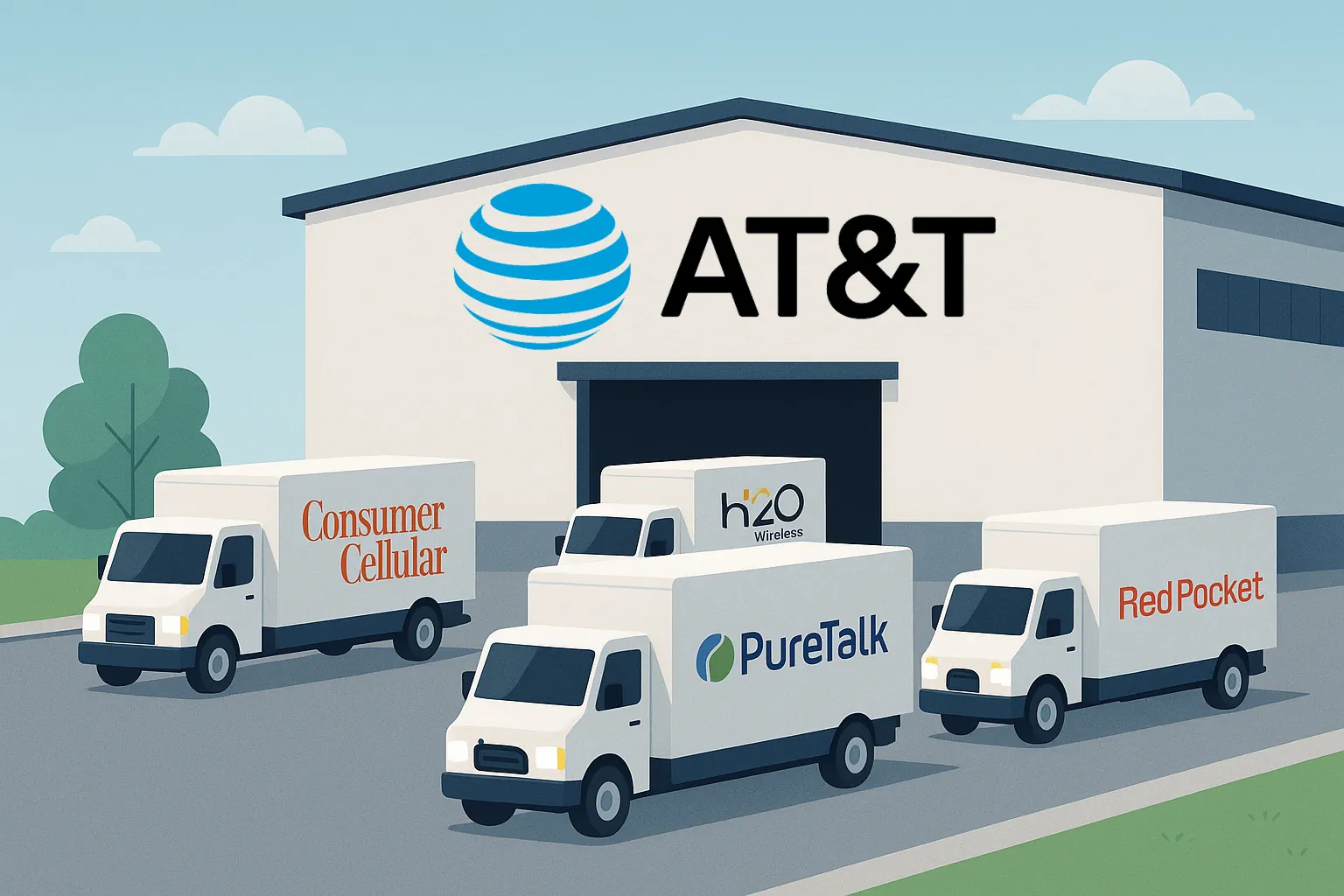
An MVNO (Mobile Virtual Network Operator) sells cell phone service using a major carrier’s network instead of owning cell towers. MVNOs lease access from one or more major carrier networks which include AT&T, T-Mobile, and Verizon to sell service under their own brand.
Think of MVNOs as retailers of wireless service. While the “product” (network coverage) comes from a major carrier, the pricing, packaging, marketing, customer service, and features are set by the MVNO. If you count individual wireless brands in the USA, most of them are MVNOs, which is why BestMVNO maintains a running list of these providers.
What is an MVNO For?
MVNOs exist to increase competition in the wireless marketplace. They also help serve niche markets that are often too small or too specific for major carriers to target directly.
Some MVNOs focus exclusively on areas like the Internet of Things or private 5G networks. Others target travelers with global eSIM plans or customers with low or highly specific data needs. From the carrier side, MVNOs allow network operators to reach additional customers and niche segments without building, marketing, or managing separate brands themselves.
Why People Choose MVNOs
Most people choose an MVNO for one simple reason: lower monthly prices. In most cases, MVNO plans are cheaper than postpaid plans from major carriers because MVNOs operate with lower overhead and aim to serve different markets.
Common reasons people switch to MVNOs:
- Better value for light or moderate users
- No contracts (most MVNOs are prepaid, a minority are postpaid)
- Online sign-up and self-service
Some customers also choose MVNOs to better serve their niche needs. Historically, MVNOs stood out by selling plans with international calling and texting. Today, those features are common across postpaid, prepaid, and MVNO brands, so modern MVNOs look to differentiate in other ways.
For example, Google Fi and US Mobile aim to serve customers with international data needs. Others, like MobileX, use AI-driven tools to help customers avoid paying for more data than they actually need.
Do MVNOs Have the Same Coverage?
Usually, yes.
If an MVNO runs on Verizon’s network, you should generally expect Verizon coverage. If it runs on T-Mobile, expect T-Mobile coverage, and so on.
That said, your experience can still vary based on:
- Domestic roaming access: most MVNOs don’t switch your phone to another network when you’re in an area without coverage
- Satellite access: postpaid providers have begun to partner with Starlink and AST SpaceMobile to allow access to satellite service in areas where your carrier doesn’t have coverage and you have a phone compatible with their networks. MVNO access to satellite coverage has yet to be announced.
Are MVNO Data Speeds Slower?
Sometimes data speeds can be slower with an MVNO, due to the MVNO having deprioritized data plans. This means that in peak usage times or in busy areas like in stadiums, or downtown corridors, the major carrier may prioritize its own postpaid customers data usage first. When that happens, MVNO speeds can slow down temporarily, sometimes to barely usable data speeds and sometimes the speed reduction is not noticeable at all outside of when running a network speed test.
Outside of congested situations, MVNO speeds can be very similar to the host network.
MVNOs often trade “premium network priority access” for lower prices.
How MVNOs Work in Simple Terms
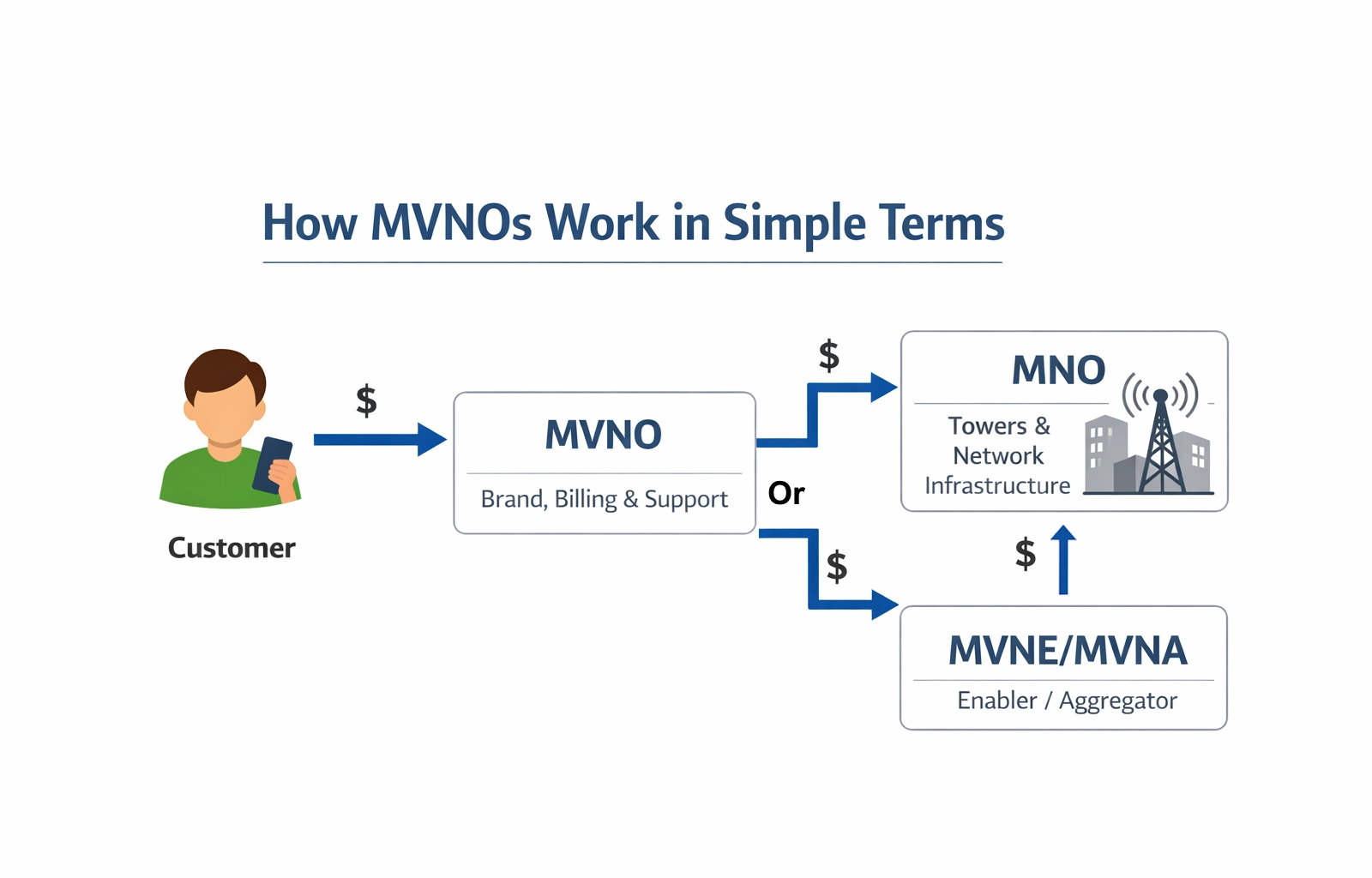
Here’s the basic model:
- An MVNO negotiates wholesale access with a carrier (or through intermediaries known as Mobile Virtual Network Enablers (MVNEs) and Aggregators (MVNAs)).
- The MVNO designs phone plans and sells them under its own brand.
- Customers use the same towers as the underlying carrier network.
- The MVNO handles operations like billing, marketing, customer support, and SIM/eSIM distribution and activation.
MVNO vs MNO: What’s the Difference?
Traditional carriers are known as MNOs (Mobile Network Operators) or companies that own and operate wireless network infrastructures.
In the U.S., there are three main traditional MNOs:
- AT&T
- T-Mobile
- Verizon
There are also emerging new age connectivity models that include satellite-to-phone services like Starlink and AST SpaceMobile and community-built networks like Helium Mobile. These are different from traditional MNOs and MVNOs, but they’re influencing how coverage and wireless service may work in the future.
An MVNO differs from an MNO because it does not own the towers it uses and instead leases network access from one (or sometimes more than one) of those carriers.
Independent MVNOs vs Carrier-Owned Prepaid Brands
You’ll often see the term “MVNO” used in two different ways online:
- Independent MVNOs: separate companies leasing access from an MNO
- Carrier-owned prepaid brands: brands owned by the same company that owns the network
Many consumer sites lump both together because they can look similar to shoppers (both are often prepaid and cheaper than postpaid). But from an industry and business standpoint, they operate differently. Carrier-owned prepaid brands have the advantage over MVNOs due to owner economics. The parent company that runs them owns the network they operate on so they don’t have to lease access to it.
Examples of Independent MVNOs
As of 2026, these are examples of some true MVNOs companies that are independently owned and lease access to one or more networks:
- US Mobile – Offers plans on AT&T, Verizon and T-Mobile
- Tello Mobile – Operates on T-Mobile’s network
- MobileX – Uses Verizon
- Red Pocket Mobile – Offers access to all three major U.S. networks
- Consumer Cellular – Uses AT&T’s network and is one of the few MVNOs to operate its own branded retail stores.
Carrier-Owned Prepaid Brands
These brands are owned and operated by the same companies that own the networks. They’re often cheaper than postpaid, but they aren’t independent MVNOs in the traditional sense.
| Brand | Parent Network & Brand Owner | MVNO? |
|---|---|---|
| Metro by T-Mobile | T-Mobile | No |
| Cricket Wireless | AT&T | No |
| Total Wireless | Verizon | No |
| Straight Talk | Verizon | No |
| Mint Mobile | T-Mobile | No |
| Visible | Verizon | No |
Carrier-owned prepaid brands may benefit from:
- Deeper integration with the network
- Easier and earlier access to “premium” features the network may not wholesale broadly
- Stronger device deals and promotions
Is an MVNO Right for You?
An MVNO may be a great fit if you:
- Want to lower your monthly phone bill
- Don’t need heavy carrier perks or premium bundles
- Are comfortable managing service online
- Have an unlocked phone (or plan to buy one)
You may prefer a major carrier (or a carrier-owned prepaid brand) if you:
- Want premium perks bundled into your plan
- Want the best device financing or trade-in deals
- Prefer in-store support
- Want a big discount for multiple lines
Next: How to Get an MVNO Plan
BestMVNO offers various phone plan comparison guides and recommendations to help you choose the best MVNO phone plan or carrier-owned prepaid brand to match your needs. Switching to one is easy. Once you find a plan you like, many will allow you to switch instantly if you have an eSIM compatible device. You can activate new lines of service with a new phone number or port your number in.
If you’re ready to shop, see our up-to-date MVNO and carrier phone plan comparisons: