
Advertisement
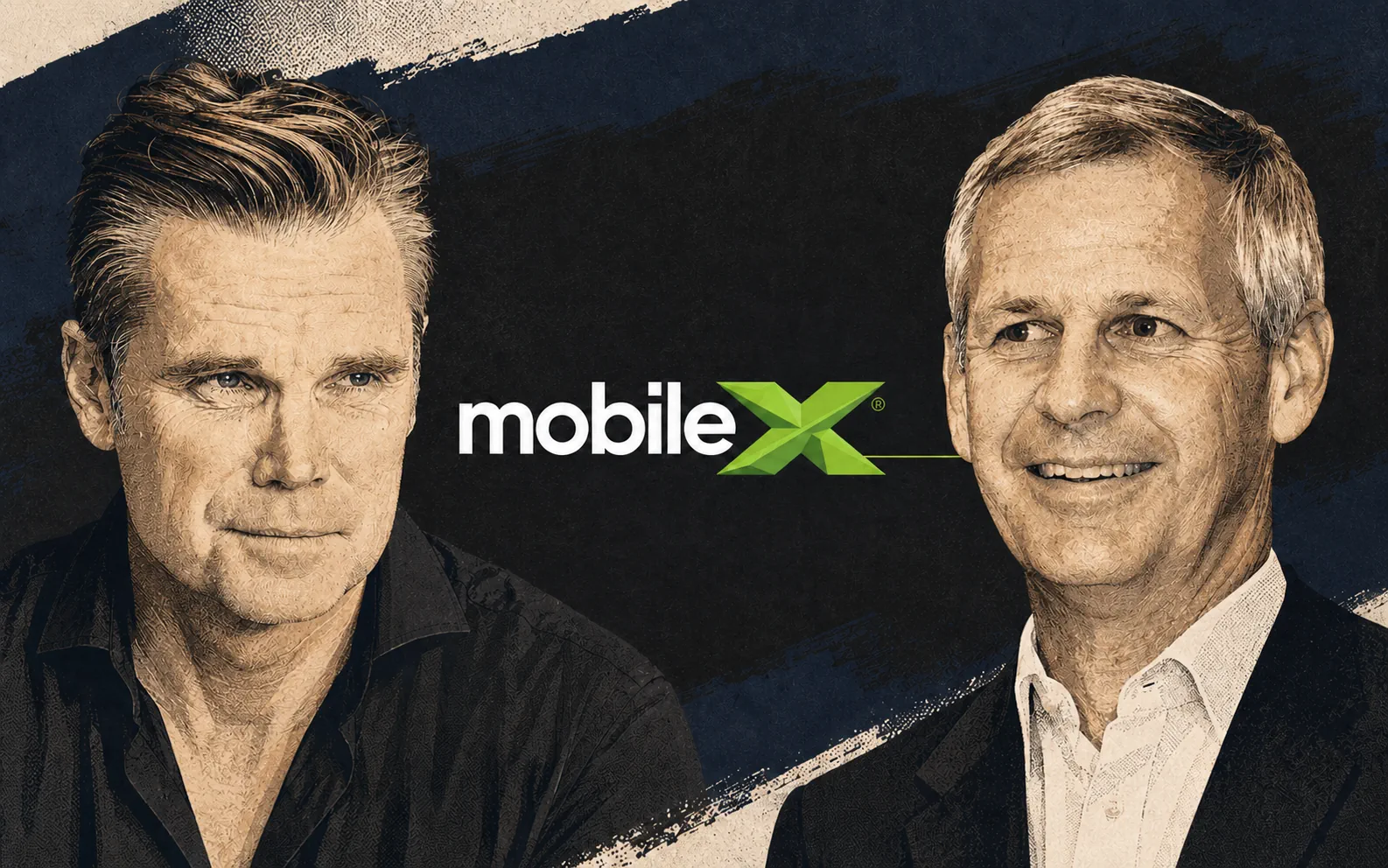
Charlie Ergen has agreed to take control of MobileX, but the wireless provider’s founder, Peter Adderton, isn’t going anywhere.
The Wall Street Journal reports that Ergen will acquire a controlling stake in MobileX through CONX (stock symbol CNXX), his special purpose acquisition company. The deal values MobileX at approximately $200 million and remains subject to regulatory approval. Dealroom also reported that Adderton will remain MobileX’s chief executive.
The transaction will also make Verizon a minority owner of MobileX. Verizon is reportedly converting a loan it made to the company into equity.
MobileX began beta testing in November 2022 before launching nationwide in February 2023 on Verizon's network. The MVNO offers highly customizable plans and uses artificial intelligence to help subscribers estimate how much data they need. Its SIM cards are now sold in approximately 3,700 Walmart stores, online and through a growing independent dealer network.
This Is MobileX’s Second Run At A Public Listing
MobileX previously attempted to enter the public markets through a reverse merger with industrial sensor manufacturer Electro-Sensors.
The companies announced the transaction in June 2022, several months before MobileX began beta testing. Electro-Sensors would have been renamed Mobile X Global, with the combined company continuing to trade on Nasdaq under the ticker symbol “MOBX.”
Mobile X Global shareholders were expected to own approximately 76% of the combined company. Electro-Sensors shareholders would have controlled approximately 11%, while investors providing $20 million in new equity financing would have received the remaining 13%. The financing agreement also called for a potential $50 million equity line of credit.
Although Electro-Sensors was an operating company rather than a traditional blank-check SPAC, the reverse merger offered MobileX the same basic shortcut to a public listing.
The transaction never closed. In January 2023, Electro-Sensors and Mobile X Global terminated the merger after they were unable to secure the required $20 million PIPE investment due to difficult financial market conditions.
On the headline numbers, the new deal’s approximately $200 million valuation is 10 times the $20 million figure attached to MobileX’s first public-market attempt. The comparison is not perfectly apples-to-apples because the earlier $20 million represented required PIPE financing, while the latest $200 million figure is a reported company valuation. Still, MobileX is being assigned substantially more value now that it has launched service, gained national Walmart distribution and established an independent dealer presence.
MobileX Needed A Larger Financial Backer
MobileX has built a national distribution footprint, developed its own platform and assembled a competitive collection of plans. What it has not had is the financial scale enjoyed by many of the brands it competes against including MVNOs like US Mobile who are backed by venture capital.
Running a national wireless brand requires money for advertising, retail inventory, dealer commissions, device promotions, customer acquisition, support operations and continued development of the MobileX app and platform. Aggressive introductory offers may also require a provider to accept losses upfront and wait months to recover the cost of acquiring a customer.
Carrier-owned prepaid brands have more room to play that game. Verizon owns Visible, Total Wireless, Straight Talk and Tracfone. T-Mobile owns Metro, Mint Mobile and Ultra Mobile. AT&T owns Cricket Wireless. Their parent companies own the networks and can decide how aggressively their prepaid brands are allowed to price service.
Independent MVNOs buy data wholesale from the same companies they compete against at retail.
MobileX received a painful reminder of that disadvantage in 2025 when it was forced to reduce its $24.88 unlimited plan from 199GB of high-speed data back to 30GB. Adderton told BestMVNO at the time that the wholesale pricing needed to continue offering 199GB had not been extended and that MobileX could not match competing unlimited offers without losing money.
More funding cannot fix unfavorable wholesale economics by itself but it can allow MobileX to make larger traffic commitments, negotiate from a stronger position and survive longer promotional payback periods. Ergen also brings relationships with every major network operator, while Verizon’s new equity position gives it a financial interest in seeing MobileX grow.
The Verizon loan conversion should reduce at least some pressure on MobileX’s balance sheet. Fresh capital from CONX could then be directed toward expansion instead of servicing debt, although the full financing structure has not yet been disclosed.
Could MobileX Add AT&T And T-Mobile?
EchoStar has extensive wholesale relationships with AT&T and T-Mobile. AT&T became EchoStar’s primary network services partner under an expanded long-term wholesale agreement, while EchoStar’s 2026 quarterly filing says its wireless operations continue to depend on both AT&T and T-Mobile for network services.
Those contracts belong to EchoStar, not CONX or MobileX, so MobileX does not automatically gain access to either network through this transaction. New agreements, contract amendments or deeper coordination between Ergen-controlled companies would likely be required for MobileX to gain additional network access.
If Ergen can use those relationships to bring AT&T and T-Mobile coverage to MobileX, the brand would become a much more direct competitor to major carriers and multi-network MVNOs like US Mobile. It could combine three-network access with its personalized plans, Walmart distribution, priority-data options and AI-powered usage platform giving it a big advantage over US Mobile and other brands.
Multiple networks would also give MobileX more leverage when negotiating wholesale costs. If one carrier’s terms prevent MobileX from competing at a particular price point, the company could direct new activations toward another network offering better economics.
Verizon’s ownership creates an additional wrinkle. Verizon may want MobileX to remain centered on its network rather than become a platform that also sends subscribers to AT&T and T-Mobile. The rights attached to Verizon’s minority stake have not been disclosed, so it is too early to know how much influence it will have over future network expansion.
Adderton Is Closer To Boost Mobile Again
The Boost Mobile angle is impossible to ignore.
Adderton launched Boost Mobile in the United States with Nextel in 2001 before Nextel acquired the business. He has spent years trying to become involved with the brand again. In 2019, he said he was willing to pay as much as $2 billion to reacquire Boost while Sprint was preparing to sell it. He again worked on a possible bid in 2022 after Boost had been acquired by Dish Network.
In July 2025, Fierce Network reported that EchoStar was considering a combination of MobileX and Boost Mobile. Adderton subsequently said he was not directly negotiating with EchoStar, but he made his interest clear.
In a LinkedIn post responding to that report, Adderton said he would love to help return Boost to its glory days. He also argued that a combination of Ergen, MobileX and Boost could reshape the U.S. wireless market. At the time, he described it as a dream he had held for years.
One year later, Ergen is taking control of MobileX.
The current transaction of course does not put Adderton in charge of Boost Mobile. Boost is owned by EchoStar, while MobileX will be controlled through CONX. They are separate companies even though Ergen controls both.
It does create a direct business relationship between Adderton and the person who ultimately controls Boost. Coordinating the two brands, sharing technology and back-office operations, combining dealer resources or eventually putting Adderton in a broader wireless leadership role would now be much easier.
Boost could offer MobileX immediate scale, a large retail dealer network, device purchasing power and millions of subscribers. MobileX could give Boost its customizable plan platform, a stronger digital experience and a leader with a history of building a prepaid brand around culture instead of treating it like a smaller version of postpaid.
EchoStar reported 7.527 million wireless subscribers across its brands as of March 31, 2026. MobileX cannot reproduce that scale quickly, while Boost has been unable to turn its size into sustained momentum. There is a potential fit if Ergen decides to bring the businesses closer together.
From Ergen Critic To Ergen Partner
There is plenty of irony in Adderton agreeing to work with Ergen.
Adderton has spent more than five years publicly criticizing how Dish and EchoStar managed Boost Mobile. He has repeatedly attacked the brand’s positioning, marketing, retail strategy and failure to grow. He has also argued that Boost needs leadership that understands prepaid consumers and its dealer network.
Ergen has now acquired the services of the person who has been one of his loudest wireless critics.
The relationship could become volatile. Adderton is outspoken, while Ergen will control the company in which Adderton remains CEO. Adderton will continue operating MobileX, but he will no longer have final control over its long-term direction.
It could also be exactly what Ergen’s wireless operations have lacked. EchoStar spent billions of dollars acquiring spectrum and constructing a 5G network, yet Ergen recently acknowledged that the company had “treaded water for four years” in wireless.
Adderton’s record is not flawless, but he has repeatedly demonstrated that he understands wireless branding, prepaid distribution, dealers and customer acquisition. He helped turn Boost Mobile into one of the most recognizable prepaid brands in the country and has built MobileX from an idea into a nationally distributed MVNO.
By leaving Adderton in the CEO position, Ergen appears to be buying more than MobileX’s subscribers and technology. He is also buying access to an experienced wireless operator and brand builder.
Editor’s Take
This is the kind of financial backing MobileX has needed to become more than a well-distributed niche MVNO.
Getting into 3,700 Walmart stores was a major accomplishment, but shelf space alone does not produce brand recognition or subscriber scale. MobileX still needs a larger advertising budget, stronger device offers, even more dealer support and wholesale terms that allow it to compete with carrier-owned prepaid brands.
The best immediate outcome would be for CONX to fund MobileX’s growth while allowing Adderton to continue operating it with reasonable independence. Verizon becoming an owner may also lead to a more favorable and stable network relationship than MobileX has had as an ordinary wholesale customer.
Adding AT&T and T-Mobile would take the opportunity much further. A three-network MobileX with Walmart distribution, independent dealers and Ergen’s financial backing would make MobileX even more of a standout and differentiated brand. It would also give consumers another independent option at a time when the major carriers increasingly control the prepaid brands competing at the industry’s most important price points.
The Boost Mobile possibilities are more speculative, but Adderton is now closer to being involved with the brand than he has been at any point since selling it. Ergen controls both sides, Adderton remains in charge of MobileX, and both men have publicly acknowledged that their wireless businesses have not yet reached their potential.
Ergen finally has someone working on an Ergen-controlled wireless brand who has experience creating, positioning and growing wireless brands. Adderton finally has a direct seat at the table with the person who controls Boost Mobile.
After years of criticism from one side and wireless struggles on the other, they now have an opportunity to prove they can build something together.
MobileX
This article is part of BestMVNO’s coverage of MobileX. Learn more about MobileX plans and coverage from BestMVNO at the links below: