
Advertisement
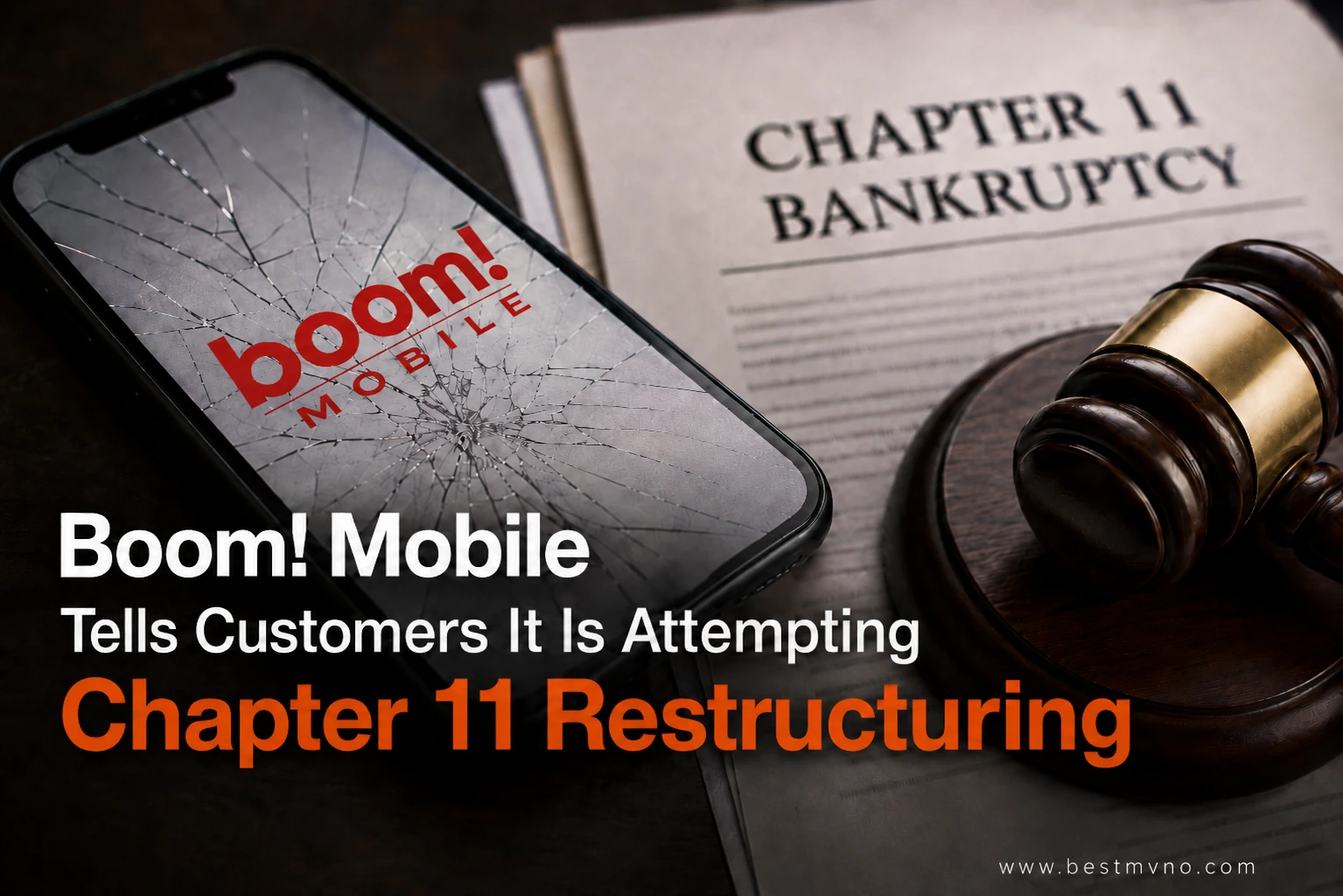
Boom! Mobile, a Tulsa-based MVNO that has operated on multiple major networks including Verizon and T-Mobile, plans to file for Chapter 11 restructuring and warned customers that service could be discontinued if the effort is unsuccessful.
The development surfaced through a post on Reddit’s r/NoContract, where a longtime Boom customer said their text messaging had stopped working and that Boom support responded by saying the company had made “the very difficult decision to restructure through Chapter 11 bankruptcy.” The message added, “If this isn’t successful, then we will discontinue Boom! Mobile service.”
A follow-up post in the same thread included a longer customer email from Boom, which apologized for the disruption and offered port-out guidance. For customers porting out from Boom Red, the company reportedly instructed them to use their phone number as the account number and 0000 as the PIN.
Boom Red has been the company’s Verizon-network service. Boom has also sold service on T-Mobile, with recent marketing and plan pages positioning the brand around two major network options. Historically, Boom also offered service under other color-coded network names, including AT&T and Sprint options before those were discontinued or changed.
Boom Mobile’s Long Road From Startup MVNO To Chapter 11
Boom Mobile launched in 2015 through Enhanced Communications Group, a telecommunications company that dates back to 1998. The brand entered the market during a period when smaller MVNOs could still compete by offering flexible plans, multi-network access, lower prices, and more personal customer support than the major carrier brands.
For years, Boom positioned itself as a customer-service-driven alternative to the major carriers. It also tried to stand out by offering access across multiple networks, something that gave customers more flexibility than many single-network MVNOs could provide.
But the wireless market Boom launched into in 2015 looks very different from the one it is trying to survive in today. Carrier-owned prepaid brands have become much more aggressive on price, and the largest carriers now use their own prepaid and flanker brands to compete directly against the independent MVNOs that buy wholesale access from them.
Boom Tried To Build More Than A Budget Wireless Brand
Boom’s Chapter 11 filing comes after a period where the company appeared to be trying to scale beyond being a small, low-cost MVNO.
In December 2025, Boom announced a brand refresh and a growth push supported by WNB Ventures, a strategic growth and deal-making firm. The release said WNB Ventures had guided Boom Mobile’s strategic expansion and partnership initiatives, helping align the brand for its next phase of growth.
That push included a larger sports and lifestyle marketing strategy. BestMVNO previously reported that Boom! Mobile signed a sponsorship deal with Thrill Sports, covering Power Slap, Street League Skateboarding, and Nitro Circus. The deal was described as a three-year, multi-million-dollar investment and gave Boom exclusive rights in the wireless service category across those properties.
The strategy seemed clear enough. Boom was trying to get in front of younger, price-conscious consumers through sports entertainment and live-event marketing, rather than trying to outspend carrier-owned brands in traditional wireless advertising.
Boom had also been active in racing sponsorships. Earlier this year, BestMVNO reported that Boom Mobile sponsored race car driver Taylor Reimer at the 2025 Chili Bowl Nationals. The company had previously sponsored Joey Hand with Rick Ware Racing and offered NASCAR-related promotions.
Those sponsorships were part of a broader attempt to build awareness around a brand that did not have the same distribution, retail footprint, or advertising budget as Metro by T-Mobile, Cricket Wireless, Visible, Total Wireless and other carrier owned prepaid flanker brands.
Boom Also Tried To Branch Out With Boom Tech
Boom’s ambitions were not limited to selling phone plans.
In 2023, BestMVNO reported that founder Jeff Holley had launched boom! Tech, an effort aimed at positioning the company as more than a retail MVNO. Boom Tech was described as a parent umbrella for Boom Mobile and Boom Moto, with plans to support operations as both a mobile virtual network enabler and mobile virtual network aggregator.
That meant Boom Tech was aiming to provide things like billing, backend systems, customer support, carrier access, and “MVNO in a Box” type services to other brands looking to enter wireless.
At the time, the effort looked like an attempt to move up the value chain. Instead of only competing for subscribers one line at a time, Boom tried to build a platform that could help other brands launch mobile service.
That would have been a logical pivot as retail wireless is hard. Platform services can create a different business model if there are enough customers, enough carrier access, and enough capital to support it. But building that kind of operation is expensive, and the retail side of the market has only become more difficult.
The MVNO Market Has Become Brutal
Boom’s restructuring is not just a Boom story. It is another example of how difficult the independent MVNO business has become. Just prior to Boom's restructuring, Helium Mobile was also pushed out of the market and sold to Noble Mobile.
For years, MVNOs had a simple pitch: keep your phone, use a major network, and pay less. But that value proposition has drastically changed over the last couple of years. Carrier-owned prepaid brands are now pushing truly unlimited data pricing down to levels that independent MVNOs often cannot match.
BestMVNO recently reported that Cricket Wireless is testing a $20/month unlimited annual plan in select markets. The plan requires customers to bring their own phone and prepay $240 for a full year of service. Around the same time, Metro by T-Mobile continued the prepaid price war with a $20/month unlimited BYOD offer requiring a six-month prepayment and a $30/month BYOD plan with hotspot.
Those offers followed aggressive moves from Total Wireless, Visible, Straight Talk, and Mint Mobile. In the span of roughly one to two years, carrier-owned prepaid brands pushed unlimited data pricing into the $20 to $30 range with increasingly aggressive BYOD deals, multi-month offers, and price guarantees.
That creates a serious problem for independent MVNOs since they don't own the networks they operate on. They buy access from the same companies now using their own prepaid brands to undercut them.
MVNOs Can’t Easily Match Their Own Suppliers
BestMVNO has covered this problem in the past in MVNOs Can’t Beat Their Suppliers on Price. So What Comes Next? and MVNOs Must Be Allowed to Offer Truly Unlimited 5G, Their Survival May Depend on It.
If Verizon, T-Mobile, or AT&T decide to sell truly unlimited data through their own prepaid brands at $20 to $30 per month, independent MVNOs are left trying to compete against their own suppliers. But most MVNOs are not given the same economics, the same network flexibility, or the same ability to offer truly unlimited high-speed data at those prices and may not even be profitable selling at lower prices to low data users.
A carrier-owned brand can sell a plan at a lower margin if it helps protect market share, fill unused network capacity, reduce churn, or support a broader prepaid strategy. An independent MVNO generally has to pay wholesale rates, cover customer support, billing, taxes, marketing, payment processing, and fraud risk, and still have enough margin left to survive.
It is even harder when carrier-owned brands can also bundle in perks that independent providers may not be able to match, including device promotions, home internet discounts, rewards programs, retail distribution, free trials, and broader customer retention tools.
Editor’s Take
Boom Mobile’s Chapter 11 filing is a rough outcome for a brand that had been around the MVNO space for a long time and had recently been trying to build more visibility.
The company did not sit still as it pursued sports sponsorships, tried to build a lifestyle angle around the brand, partnered with WNB Ventures, sponsored racing, and launched Boom Tech as a bigger platform play. Those are not the moves of a company that was simply ignoring the market.
But brand-building does not fix wholesale economics.
If an MVNO is trying to sell capped or limited data plans while carrier-owned prepaid brands are advertising truly unlimited data at $20/month, the smaller provider is put in a very difficult position. It can lower prices and risk destroying its margins, or it can hold pricing and watch customers compare it against Metro, Visible, Total Wireless, Cricket, or Mint Mobile.
This is the part of the market that should worry independent MVNOs. The carriers can use their own prepaid brands to set the public-facing price floor while still controlling what their wholesale partners are allowed to sell. That leaves MVNOs fighting for niches, service quality, affinity branding, bundles, or platform plays rather than competing head-to-head on unlimited data.
Some can survive that. Many cannot.
For customers, Boom’s situation is also a reminder that very small providers can offer good pricing and personal support, but they may carry more continuity risk than brands owned by the national carriers or larger MVNO operators. Customers with active Boom service should pay close attention to port-out instructions and should avoid canceling service before a number transfer is complete.
For the broader prepaid market, Boom Mobile’s restructuring is another warning sign. Lower prices are good for consumers today, but if the current pricing war wipes out too many independent providers, the long-term result could be fewer choices and less innovation.
Boom’s attempt to restructure may still give it a path forward. But the bigger problem facing MVNOs is not going away. As long as independent providers are expected to buy access from companies that are also aggressively competing against them at retail, more brands are going to find themselves squeezed and fail.
Boom! Mobile
This article is part of BestMVNO’s coverage of Boom! Mobile. Learn more about Boom! Mobile plans and coverage from BestMVNO at the links below: