
Advertisement
There was a time when MVNOs could count on one big advantage: they were the cheaper alternative. They could come in under the major carriers, offer a simpler plan lineup, and win customers who did not want to pay for bloated service from their postpaid or prepaid brands.
That advantage is getting harder to hold onto.
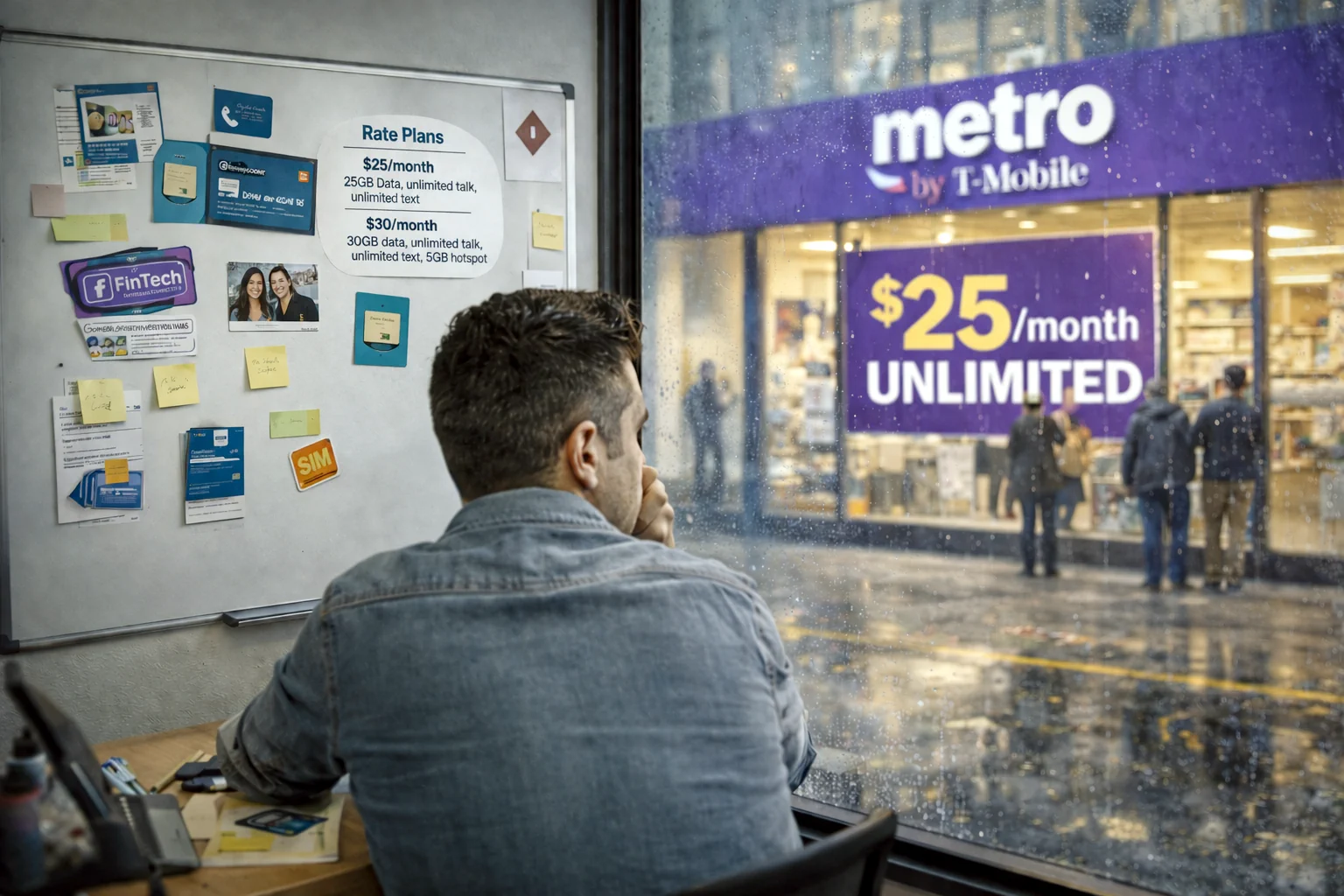
As of March 2026, supplier-owned prepaid and flanker brands are increasingly selling at the exact price points that independent MVNOs built their businesses around. Total Wireless is advertising a single-line BYOD unlimited plan for $20 per month with a five-year guarantee. Metro by T-Mobile is offering one line of unlimited 5G data for $20 per month when prepaid for six months, and also has a $25 monthly BYOD option. Visible continues to sell unlimited plans at $25 per month, while Cricket offers a $25 multi-month unlimited option.
And it is not just the raw price point that is becoming a problem. Supplier-owned brands can often bundle in things many independent MVNOs struggle to match at those prices, including broader device promotions, free trials, rewards programs, weekly perks, home internet, smartwatch plans, hotspot-device plans, and access to truly unlimited or less-constrained data options on their own networks. Visible, Cricket, Straight Talk, Total Wireless, and Metro by T-Mobile all offer all or some of either free trials, rewards programs, or discounted 5G home internet.
That is a real problem for standalone MVNOs, the host networks are competing and doing it with structural advantages.
If you own the network, you do not have to preserve someone else’s wholesale margin. If you own the network, you decide who gets the best economics, the cleanest onboarding, the best upsell paths, and the strongest retention hooks. So if an independent MVNO is still trying to win mainly by saying “we’re cheaper” or “we’ve got international calling,” its pitch is much weaker than it used to be.
So what should MVNOs do instead, especially when their network suppliers have elected to compete in price against them? This is a question I posed to social media over the weekend with responses ranging from: creating real brand identity and loyalty, to if the carriers are already competing against MVNOs in pricing, promos, and priority access, the MVNOs have already lost, that is, unless they get access to the same economics as the carrier.
The Old MVNO Playbook Is Breaking
For a long time, the default answer to this problem would have been simple: find a niche.
Target seniors. Target international callers. Target students. Target families. Target people who want to save money and do not care about perks.
But many of those lanes are either crowded, weakened, or easy for supplier-owned brands to step into.
International calling is no longer the differentiator it once was. Carrier-owned prepaid brands now include international features, and consumers increasingly rely on apps like WhatsApp and Telegram for communication. Seniors are already served by established players like Consumer Cellular and Affinity Cellular, and major carriers and their prepaid brands including Mint Mobile are now actively marketing to them.
MVNOs have to recognize that they cannot beat supplier-owned brands at their own game. A carrier-owned brand can wake up tomorrow and match or undercut a price, throw in richer perks, or decide that “unlimited” now starts at a level that wipes out half the independent market, something they've already moved to do. If your entire strategy is being a slightly cheaper version of the same network, you are building on borrowed time.
“Brand identity” by itself is not enough either. A generic lifestyle brand with a SIM card attached to it is still just another reseller if it has no real distribution advantage, no deeper utility, and no reason for the customer to stay beyond the monthly rate. Brand only matters if it is tied to belonging, trust, community, software, or an existing customer relationship that the network owner does not directly control. That is the distinction more MVNOs are going to have to understand and leverage to their benefit.
How Cable Companies Worked Around This
If you want to see what has worked in wireless, look at cable who accumulated millions of subscribers.
Comcast ended 2025 with 9.3 million wireless lines after adding 1.5 million for the year. Charter ended 2025 with 11.8 million mobile lines after adding 428,000 in the fourth quarter alone. Spectrum Mobile requires Spectrum Internet, and Xfinity Mobile is tied to Xfinity internet eligibility.
Cable did not win by building better standalone mobile brands than Metro, Cricket, or Visible. It won by turning wireless into a retention product for a bigger household relationship, an ecosystem.
That is a lesson. Wireless becomes far more powerful when it strengthens another business the customer already uses and values. For Comcast and Charter, that business was home internet. For somebody else, it could be a membership program, a payroll platform, a remittance app, a college affinity program, a business-services bundle, or a property-management offering.
The Next MVNO Isn’t Just a Phone Company
The MVNOs most likely to survive this shift are not the ones trying to be better telecom companies, but ones with additional focus.
BestMVNO reported last year that Klarna launched a U.S. mobile plan offering unlimited 5G data, talk and text, 10GB hotspot, and priority access on AT&T’s network for $40 per month. Klarna launched a mobile plan not because it wants to compete head-to-head with Metro or Visible, but because wireless can increase engagement inside its financial ecosystem. Sezzle and other Fintechs have moved in that same direction.
To a fintech, a phone plan is not just a phone plan. It can be a retention tool, a daily-engagement tool, or a subscription upsell. It's also a way to reduce churn and a way to make the app more central to a customer’s life. In that model, wireless does not have to maximize profit on its own. It only has to make the broader customer relationship stronger.
That is a fundamentally different business model than a traditional MVNO.
Collegiate Mobile's Attempt to Solve This
There's also Collegiate Mobile, which takes a completely different approach. Instead of targeting “students” as a demographic, it turns wireless service into an a sense of being and identity. Plans can be branded around specific colleges, using them for distribution, and turn a phone bill into a form of affiliation, loyalty, and support for the school. This embeds wireless as a brand and product that feels more culturally relevant or emotionally resonant to consumers inside a specific community that carriers do not own. And that is much harder to replicate than a pricing promotion.
The next wave of MVNOs might need to ask themselves: “what larger product, service, or ecosystem can wireless strengthen?”
The next winner may not be the MVNO with the cleverest rate card. It may be the one that becomes a bundled benefit inside a larger ecosystem. Or the one that powers white-labeled offers for schools, fan bases, employers, property managers, trade groups, or community institutions. The common thread is the same in every case: wireless stops being the whole reason to buy and becomes one part of a broader recurring relationship.
If MVNOs Can’t Bundle, They Need a Better Layer Above the Network
For MVNOs that cannot attach themselves to a broader business, the better path is not marketing or generic support slogans. It is building a service layer customers can actually feel.
- Defined-audience concierge service. Not generic “great support,” but support built for a specific customer base with specific needs. Consumer Cellular is the obvious example here: its business was not built on support alone, but on going after seniors and then backing that up with an operating model that made the service easier to buy, easier to understand, and easier to fix when something went wrong. The support mattered because it matched the audience. The recurring J.D. Power recognition helped validate that execution.
- Multi-network control that carrier-owned brands cannot offer. This is one of the few structurally defensible angles left. If an MVNO can let customers move among AT&T, T-Mobile, and Verizon based on coverage, performance, travel needs, or failover logic, that is something a carrier-owned prepaid brand is never going to match. US Mobile and Red Pocket have already shown customers value network choice. The opportunity is to make that choice simpler, smarter, and more automatic.
- Workflow tools, not just wireless access. The real opening may be in features that solve operating problems instead of marketing problems: small-business device management, temporary lines for seasonal workers, family admin dashboards, travel eSIM failover, expense controls, fleet-style controls for field teams, or specialized onboarding for immigrants, seniors, or remote workers. Big carriers can build some of this, but they usually do not care enough to tune it for narrow audiences. A focused MVNO can.
So Are The Days of Standalone MVNOs Over?
Not completely.
But the way the market has moved, the days of plain, vanilla standalone MVNOs may be numbered. The brands most at risk are the ones still trying to survive as little more than resellers of commodity access, hoping the network owner leaves enough margin on the table for them.
The ones with the best odds to survive and even thrive will run lean, keep acquisition costs low, deliver excellent support, control a unique distribution channel, attach wireless to a broader product, or build a service layer above the network that customers actually value.
But the traditional model looks weaker every year.
And unless regulators eventually force a more competitive wholesale environment, including better conditions for MVNOs trying to compete on data-heavy offerings, the pressure to evolve will keep growing. But regulation is not a strategy, either is waiting around for a better wholesale deal.
For many MVNOs, the future is not about becoming a better cheap phone-plan seller. It is about becoming something more useful, more embedded, and harder to replace than a cheap phone-plan seller.