
Advertisement
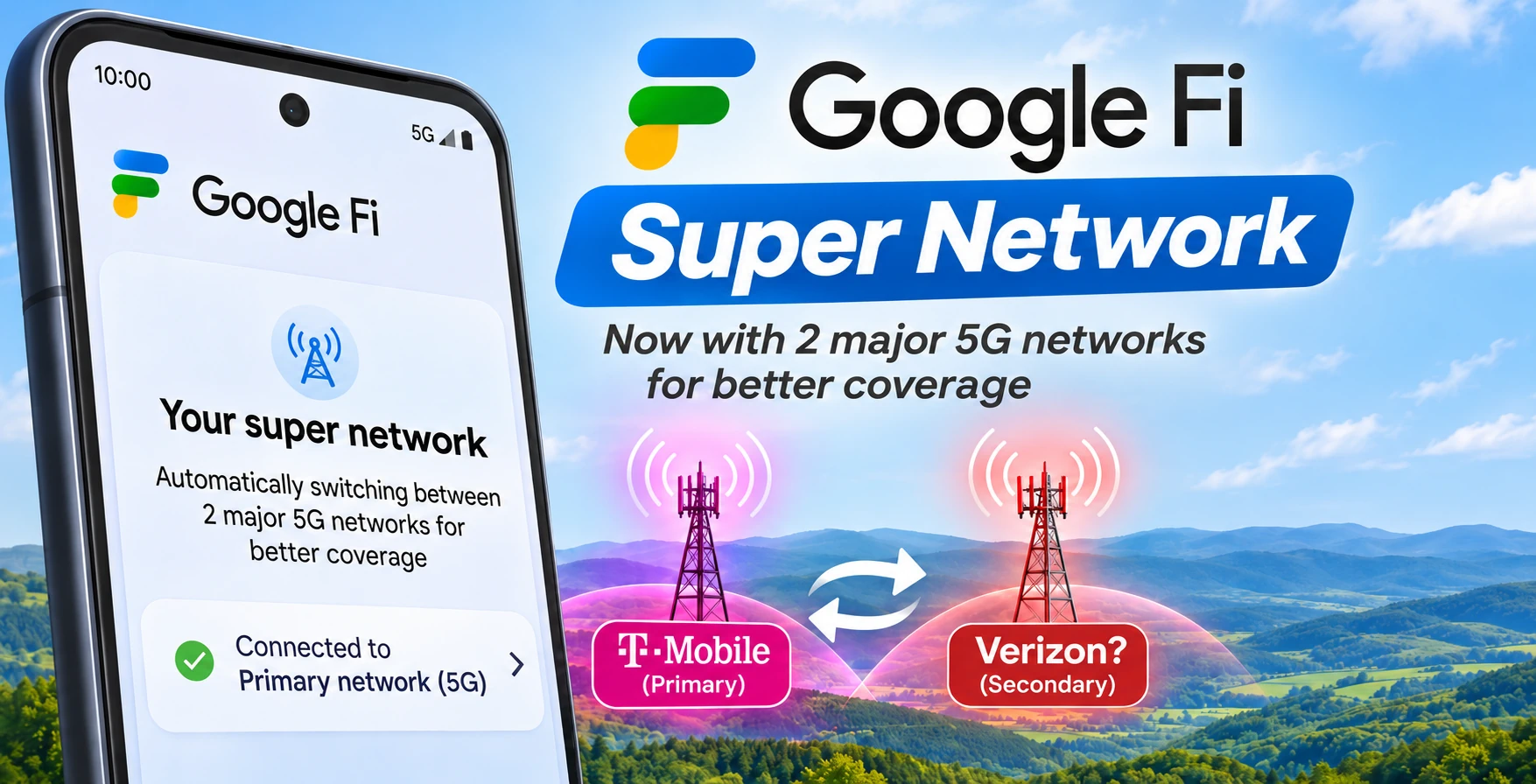
Google Fi Wireless announced on November 10, 2026, the launch of what it calls its "Super Network," allowing subscribers to automatically switch between two major US 5G networks for improved coverage and reliability. The feature is rolling out to Pixel 9 and newer devices and is included with all Google Fi phone plans at no additional charge.
The announcement marks a return to multi-network coverage for Google Fi, which has relied primarily on T-Mobile since ending its partnership with US Cellular in 2023. Google Fi has has declined to identify the second provider, but there are indications that Verizon is the new secondary network partner.
The new service also includes expanded access to millions of Wi-Fi connections through Google Fi's Wi-Fi Auto Connect+ feature.
How Google Fi's Super Network Works
Google Fi's new network switching feature uses a technology called Multiple Enabled Profiles (MEP). It allows a compatible phone to maintain two active eSIM profiles on a single embedded SIM chip.
Instead of requiring customers to manually change networks, Google Fi continuously evaluates connection quality to determine when switching networks would provide a better experience.
The system considers several factors, including signal strength, network availability, data speeds, latency, and the phone's battery level.
If the primary network is functioning well, Google Fi keeps the subscriber connected to it. However, if the signal weakens or the connection becomes unreliable, the phone can automatically move its data connection to the secondary network when that network offers significantly better performance.
For example, a subscriber traveling through an area with poor T-Mobile coverage could automatically switch to the second network without changing phone settings, installing another SIM, or transferring their phone number.
According to Google Fi's support documentation, voice calls made while connected to the secondary network are routed over the data connection.
Google Fi also uses thresholds to prevent phones from constantly switching between carriers when network conditions fluctuate. Switching becomes less frequent when Battery Saver is enabled or the phone's battery is low.
There is no manual switching option at launch.
The Google Fi app includes a new "Your Super Network" section that identifies whether a subscriber is connected to the primary or secondary network. It also provides a history of recent network switches.
One other noteworthy detail involves data priority. According to 9to5Google, Google Fi says customers will continue to receive top-priority data access on the primary T-Mobile network and the secondary network will also have priority data. This could help preserve performance when a network becomes congested, although actual speeds will still depend on local network conditions.
Device Compatibility Is Initially Limited
Although Google Fi is including domestic network switching with all its plans, not every subscriber will be able to use it immediately.
The requirements include:
- A US-market Google Pixel 9 or newer device.
- A fully unlocked phone running updated software.
- An active Google Fi eSIM rather than a physical SIM.
- No other active SIM profiles from another carrier.
- A regular Google Fi phone plan, excluding its free trial.
Subscribers using older Pixels, iPhones, Samsung phones, and other devices will continue to receive service on Google Fi's primary cellular network without the new domestic switching capability.
The requirement to disable other active SIMs is a significant limitation for customers who use dual-SIM phones to maintain separate personal and work lines.
Google Fi previously offered automatic domestic switching when it launched as Project Fi in 2015. Initially, customers could switch between T-Mobile and Sprint, with US Cellular later becoming another network partner. T-Mobile's acquisition of Sprint in 2020 and Google Fi's departure from US Cellular in 2023 eventually left the service dependent primarily on T-Mobile.
The new implementation uses more modern eSIM technology to make switching faster and less disruptive but customers lose the ability to manually switch networks.
Why Verizon Is Likely Google Fi's Second Network
Google has been unusually secretive about the identity of its new network partner.
The company's official announcement refers to the networks only as two of America's best 5G networks. It does not specifically identify T-Mobile, Verizon, or AT&T.
However, there are clues out there as to which network is being used.
One clue comes from Google's updated coverage maps.
Google Fi has introduced a super network coverage map that distinguishes between areas covered by both 5G networks, the primary 5G network, and the secondary 5G network. The map also shows areas with 4G LTE service.
In a November 10 Ars Technica report, Ryan Whitwam suggested that Verizon was the more likely secondary partner after comparing the shape of the coverage gaps shown on Google Fi's map with those of the major carriers.
And Sneed Mobile Tech shared in a YouTube video a speed test sent to him of someone connected to Google Fi's new Super Network and it was on Verizon.
The dual network combination could improve Google Fi's competitiveness in rural markets, along highways, and inside buildings where one carrier's network performs better than another.
How Google Fi Compares To US Mobile's Multi-Network Coverage
Google Fi is not the first MVNO to offer access to multiple national wireless networks.
US Mobile already provides service across all three major networks under its Warp, Dark Star, and Light Speed brands.
- Warp: Verizon
- Dark Star: AT&T
- Light Speed: T-Mobile
US Mobile offers two different methods for customers to take advantage of those networks.
The first is its network transfer feature, previously known as Teleport. Customers can use their account dashboard or the US Mobile app to transfer their existing phone number between the three networks without leaving US Mobile.
The first two network transfers are free. Additional transfers cost $2 each, while Unlimited Premium customers receive unlimited free transfers, subject to US Mobile's switching-frequency limits.
US Mobile currently allows up to eight transfers per 30-day cycle, with at least four hours between transfers.
US Mobile's Multi-Network Add-On Is A Closer Competitor
US Mobile's second option, its Multi-Network add-on, is more directly comparable to Google Fi's new service.
For $10 per month per additional network line, customers on eligible plans can add another network to their existing service. The add-on costs $90 annually per additional line when paired with an eligible annual plan.
US Mobile supports up to two additional network lines, allowing a compatible phone to have access to all three major carriers while sharing the primary plan's data allowance.
Unlike a standard network transfer, the additional lines remain active on the device.
Customers can manually choose which network to use for mobile data. Depending on their phone, they can also enable automatic data switching through the operating system.
For instance, US Mobile's support documentation explains that iPhone users can enable Apple's Allow Cellular Data Switching setting. Compatible Samsung and Google phones also offer automatic data-switching options.
US Mobile's additional network subscriptions have separate phone numbers, even though their data allowances are shared. Network selection and automatic failover depend on the capabilities and settings of the device.
Google Fi's new implementation is integrated directly into its service and uses network-quality measurements and switching thresholds to determine when to move the subscriber's data connection. It does not require customers to purchase a second line or manage multiple phone numbers.
Google Fi's biggest advantages are simplicity and the lack of an additional monthly charge.
US Mobile offers more flexibility by allowing customers to choose among all three major networks, including the ability to select their primary network. It also supports a much broader range of devices.
RedPocket's CoverageGenius Offers Another Approach
RedPocket is another MVNO that offers plans across all three major networks.
Like US Mobile, RedPocket allows subscribers to choose which network provides their service. It uses the GSMA designation for AT&T, GSMT for T-Mobile, and CDMA for Verizon.
RedPocket's CoverageGenius feature allows customers to change their underlying network from within their account while retaining their phone number.
The process uses eSIM technology, although customers who prefer physical SIM cards can contact RedPocket support to arrange a network change.
CoverageGenius is different from Google Fi's super network because switching is initiated by the customer. It does not monitor signal quality or automatically move subscribers to another carrier when coverage deteriorates.
There are also financial considerations.
RedPocket says that customers who switch networks immediately will be charged for a new plan, with their previous plan canceled and unused service days generally not refunded. Customers changing networks within their first seven days of service can receive a refund of the plan charge associated with the switch.
RedPocket also offers an option to delay a network change, and customers with device rebates or promotional phone credits need to be careful. Switching networks can cause them to forfeit those incentives.
CoverageGenius is therefore better suited for someone who wants to change their preferred network than someone who regularly needs coverage from multiple carriers.
It gives RedPocket customers network choice without requiring them to leave the provider, but it is not an equivalent to Google Fi's automatic switching or US Mobile's Multi-Network add-on.
Google Fi Also Expands Wi-Fi Auto Connect+
Alongside the cellular network improvements, Google Fi announced an expansion of its Wi-Fi Auto Connect+ feature.
The service automatically connects supported phones to participating Wi-Fi networks in airports, shopping malls, stores, restaurants, and other public locations.
Google Fi says the feature now has access to millions of locations, providing another way to maintain connectivity when cellular coverage is weak or networks are congested.
Connections are automatically encrypted through Google's Virtual Carrier Network, helping protect customer data on supported Wi-Fi networks.
Wi-Fi Auto Connect+ is available on Pixel 5a and newer devices and is expanding to select Samsung phones running One UI 9 or higher and certain Motorola phones.
Google Fi also supports automatic switching between international cellular networks on eligible Pixel 7 and newer devices. International network switching is included with its Unlimited Premium and Flexible plans, which provide coverage in more than 200 destinations.
Editor's Take
Google Fi's return to multi-network coverage is a significant improvement to its wireless service.
T-Mobile and Verizon have different strengths and weaknesses in their coverage footprints. Access to both could substantially improve service for customers who frequently travel through areas where neither network provides consistently reliable coverage.
Google Fi also has an advantage in how it has implemented the feature. The ability to automatically move between networks using one phone number, without purchasing an add-on or managing separate cellular lines, removes much of the complexity that can come with multi-network service.
But there are trade-offs.
US Mobile already offers access to all three nationwide networks, lets customers manually transfer their existing number between them, and offers a paid Multi-Network option that can also support automatic data switching on compatible phones. RedPocket provides similar freedom to choose among all three networks through CoverageGenius, although changing networks involves a service-plan transfer.
Google Fi customers don't have those same choices. They cannot select their preferred primary network or manually force a switch to the secondary network. Instead, they must rely on Google's software to determine when switching is appropriate.
The initial Pixel-only restriction also limits the feature's usefulness. US Mobile and RedPocket support a far broader range of smartphones, including iPhones.
The launch does add more competitive pressure on other MVNOs to offer multi-network access without requiring customers to manually manage network changes or pay for separate service lines.
Google Fi
This article is part of BestMVNO’s coverage of Google Fi. Learn more about Google Fi plans and coverage from BestMVNO at the links below: